
Strategy and dialogue
for chatbot
Aug. 23–
Sept. 23
Conversation
designer
Since launching on October 12, 2022, the Arizona State University Online chatbot has become a core support channel, maintaining a 90.94% deflection rate, saving 8,477 agent hours, and reducing support costs by $339.1K as of July 12, 2023.
What began as an initiative to extend 24/7 support has evolved into a broader strategy to streamline student services and strengthen conversion pathways. With a proven operational impact, the ASU Online team is now exploring how the chatbot can play a more intentional role in enrollment outcomes.
Our chatbot has the ability to ask follow-up questions and deliver contextual replies after the initial user interaction, but this capability wasn’t being leveraged to support enrollment goals.
To evaluate its potential, I identified high-intent question/answer pairs within existing conversations and designed targeted follow-up replies that guided users toward next steps, specifically, completing an application. This experiment established a foundation for using conversation design to influence conversion behavior, not just deflect support volume.
.png)
All chatbot intents and dialogs are sorted into one of five categories:
Using these categories as my entry point, I reviewed our spreadsheet of chatbot content to spot question/answer sets that showed strong signs of application intent. Once I scoped out the most promising options, I decided to center the pilot on a small group within the Application category.
Most questions in this category reflect genuine interest in applying to ASU. While many responses already linked to admissions pages, a few weren’t fully supporting the user’s momentum. After weighing the pros and cons of each set and checking in with the team throughout the process, I landed on three to test.
.png)
The proposed sequence for introducing the follow-up reply was:
.png)
And would look like this:
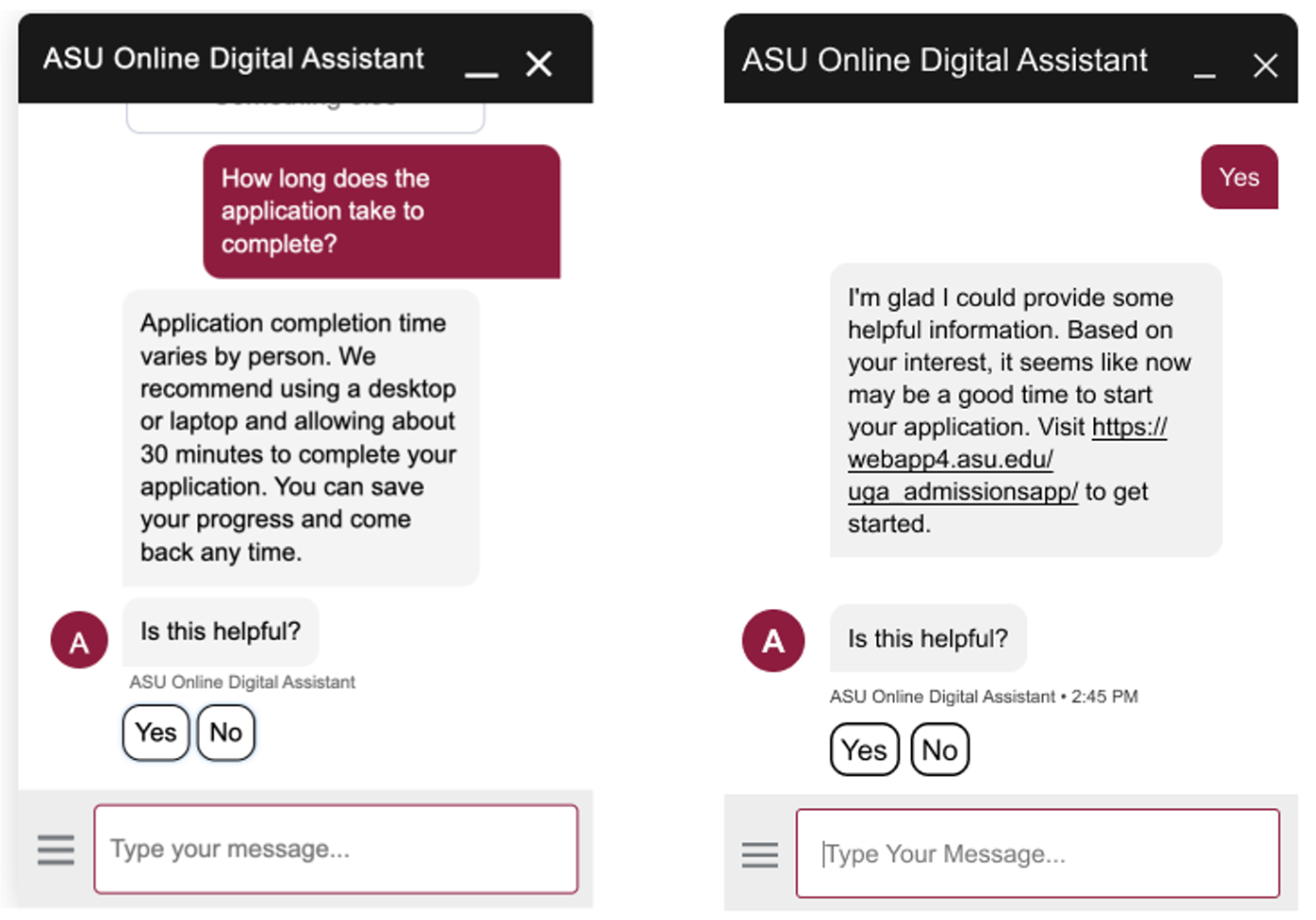
From the start, I knew I wanted input from the rest of the UX writing team. I drafted four potential replies as a starting point so we could review them together and align on the final direction. Getting early feedback helped surface what felt natural for the chatbot and what could better support conversion.
.png)
When crafting these replies, I drew on the chatbot personality work I had developed earlier. The chatbot was originally launched under a tight deadline, which meant there was no formal persona or writing guidance in place. To create more consistency and support future improvements, our team began building a unified writing guide for the chatbot.
While that project is still underway, we have defined an initial personality foundation for the chatbot. The next image shows a condensed version of that work.
.png)
I presented my options during a team meeting and asked for feedback. I received the following feedback which outlined the pros and cons of each option:
After reviewing feedback from the team, I refined the copy to be more direct and confident. I removed tentative language and tightened the structure so the guidance felt clear and actionable. Based on team input, I selected option one as the strongest direction and finalized it as:
"I'm glad I could provide some helpful information. Based on your interest, now is an ideal time to begin your application. Visit [URL] to get started."
Once approved, I delivered the updated copy to our Salesforce team for implementation in the chatbot.
To move this from a copy improvement to a measurable conversion initiative, we outlined a short-term experimentation plan with the Salesforce and analytics teams. The follow-up reply will be added to selected high-intent question/answer sets, and performance will be evaluated over the next few months. Metrics include:
If the initial results show lift, we will expand this approach to additional intents and build a more structured conversation flow that supports enrollment readiness. Long term, this work can inform a broader strategy for using the chatbot as an early conversion channel rather than only a support tool.
Presenting early options helped surface uncertainty in the phrasing and gave me direction for tightening tone and intent. Multiple rounds of feedback allowed me to sharpen the message and land on a clearer, more authoritative reply.
Ensuring the reply aligned with the chatbot’s personality was essential. By revisiting the persona work and sharing drafts across the team, I refined the copy to stay consistent with the brand while still encouraging action.